Connection, Growth, and Impact Through the Asian Health Promoter
The Asian Health Promoter is about more than providing free health screenings and promoting health education; it is about building trust, fostering meaningful relationships, and serving underserved and often overlooked communities with compassion. Recently, lead coordinators Andrew Nguyen and Lainie Galdo helped expand this initiative through a new partnership with Divine Mercy Parish, broadening the program’s reach within Philadelphia’s Asian communities. Andrew and Lainie also shared the program’s impact and research findings at the Greater Philadelphia Asian Studies Consortium (GPASC). Read on to hear their reflections on community, service, and the lessons they learned through this important work.
Andrew Nguyen (Pharmacy, ’27)
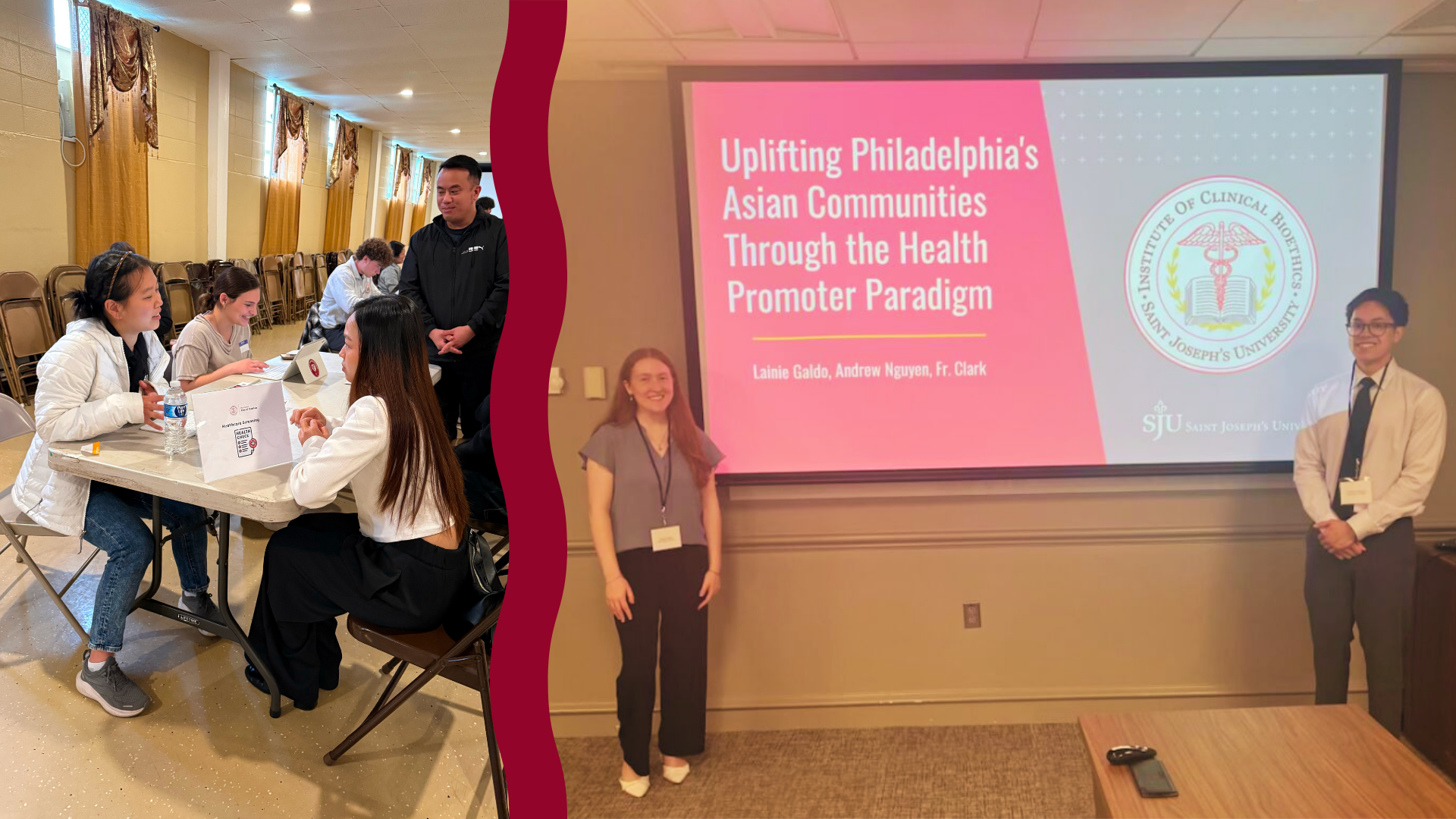
This past spring semester, Lainie and I helped open Divine Mercy Parish as the newest site for the Asian Health Promoter Program, an initiative under the Institute of Clinical Bioethics that brings free preventative screenings to underserved communities across Philadelphia. The decision to expand here was deliberate. Divine Mercy serves a predominantly Vietnamese congregation. One of the recommendations from our 2024 paper on the Asian Health Promoter was to broaden our outreach to Vietnamese parishioners specifically. As a Vietnamese American myself, being part of that expansion has felt more personal than any other project I’ve worked on. Most of the patients we screened were parishioners who came down right after Sunday Mass, often bringing a spouse or family member with them. The turnout was modest compared to what we see at Saint Thomas Aquinas, but the conversations were not.
At Saint Thomas Aquinas, we routinely see over one hundred community members at a single event because we’ve spent time building trust and embedding ourselves in the parish rhythm. At Divine Mercy, we’re starting from scratch. The challenge isn’t whether the community needs us; it’s how we communicate that we’re here, that the screenings are free, and that we’re not going to disappear after one visit. The Vietnamese community at Divine Mercy is close-knit and rooted in faith; people come because their pastor said to come, because a neighbor mentioned it, or because they saw us standing in the back at Mass. The word of mouth is slow, but it’s the only kind of outreach that actually lasts.
What I’ll carry forward is a more honest understanding of what it means to serve an underserved community. It’s tempting, especially in healthcare, to measure impact by the number of screenings, referrals, and people through the door. But the families at Divine Mercy reminded me that equity isn’t a volume metric. It’s whether the people we say we’re serving actually feel seen, and whether we’re willing to keep showing up when the turnout numbers don’t yet justify it. As I move toward a career in Pharmacy, that lesson sticks, and I hope to carry it with me wherever this professional journey leads.
Lainie Galdo (Chemical Biology, ’27)
Andrew and I presented at the Greater Philadelphia Asian Studies Consortium (GPASC) on April 18th at SJU. We presented on the Asian Health Promoter that we co-lead together. I became a coordinator at the end of my freshman year and took over as co-lead starting my junior year. The communities we serve are largely Indonesian and Vietnamese as we hold promoters at Saint Thomas Aquinas Church in South Philly and Divine Mercy Parish in Southwest Philly. We held our first promoter at Divine Mercy Parish this January, so it was a new site for us. We have had a strong relationship with Saint Thomas Aquinas Church since the origin of the Asian Health Promoter in 2022.
We had the opportunity to present at the GPASC to share our work with the Asian Studies community in the local Philadelphia region. Along with students from 11 other colleges, we shared presentations about our work. Andrew and I focused on explaining the health promoter paradigm before discussing the Asian Health Promoter. We wanted to share how we help those in the local community to people who may not know what the ICB or health promoters are. Then we focused on the Asian community and discussed issues largely seen in this community. For example, we often see dermatological issues and hypertension. When we see issues like hypertension, we have medical residents at promoters to help the patients get greater assistance. Andrew and I emphasized the ICB’s focus on continuity of care when discussing symptoms we often see at promoters. For example, the BPBuddies program is an initiative where we provide patients with blood pressure cuffs to take home and collect their blood pressure. This helps the patients get better care when the residents can read their numbers over a period of time. Then, we discussed recommendations written in “The Asian Health Promoter: Preventative Care for Philadelphia’s Vulnerable,” the ICB’s published paper on our promoter from 2024. We discussed how we have grown the promoter to develop from these recommendations made by Father Peter Clark. One recommendation we focused on related to community partnerships and meeting the unmet needs of our community. This focused on mental health care in the Asian community. Since the 2024 paper, we now have a Mental Health Table with PCOM that runs at our promoters. This helps patients get referrals if they are dealing with a mental health issue. Mental health is a stigmatized topic in immigrant communities, so we are working to provide greater education on the topic.
Overall, the Asian Health Promoter has had the highest attendance, with over 120 patients. We work closely with members of the parishes to provide quality care to our patients every month that we hold our promoter. The Asian Health Promoter, as well as every other promoter the ICB runs, works towards the Jesuit mission of men and women for others in hope of providing justice to our communities. Moments like this conference give the ICB the chance to share our work to others.