Students form the Just Healthcare in Developing Nations traveled to San José, Costa Rica for a week, to study healthcare beyond the classroom and see a universal system in practice. Through a health promoter clinic in La Carpio, they encountered both the promise of access and the realities of persistent barriers of many Nicaraguan refugees. The reflections below capture what they learned about health equity, human dignity, and the lasting impact of small acts of care.
Carly Poff ’26:
Taking the “Just Healthcare in Developing Nations” class at SJU was one of my most memorable experiences as a student, especially since it went beyond the classroom. The highlight of the course was traveling to San Jose, Costa Rica, with my classmates, where we had the opportunity to see the country’s universal healthcare system in action. One of the most impactful moments came during a health promoter event just outside of San Jose. We turned onto a bridge leading to La Carpio, a village marked by garbage-strewn streets and home to many Nicaraguan immigrants. As the event began, a community member named Vanessa shared words that stayed with me: “It’s people like you and your group that the children of La Carpio will remember” Vanessa told me. Even something as small as a toothbrush shows them the opportunities in healthcare. It might inspire them to say, “I want to be a dentist” or, “I want to be a doctor”. Being fully immersed in this environment allowed me to see both the strengths and weaknesses of Costa Rica’s healthcare system. While the country provides universal access, many communities like La Carpio still face barriers (such as limited resources, overcrowded facilities, and systemic inequities). Seeing these challenges up close made me see the complexities behind access and reminded me of the disparities that exist even within systems that are meant to serve everyone. However, beyond healthcare, I was inspired by the resilience, warmth, and openness of the people in La Carpio. I left Costa Rica remembering the faces, the laughs, and the personalities of those we met. Being immersed in their culture, traditions, and perspectives gave me a deeper understanding of how healthcare is experienced on a human level. This experience also inspired me to think about the future. While there are challenges within the universal healthcare system, I left hopeful, especially for the younger generation. Programs like the health promoter give the children of La Carpio the chance to see themselves as future healthcare leaders who can create change in their community. It made me realize that even small actions, whether handing out a toothbrush or sharing knowledge, can create a ripple effect that grows into a lasting impact. Overall, this class allowed me to combine my academics with real-world experience. I gained not only a better understanding of global healthcare that goes beyond America, but also an appreciation for the human connections that make healthcare meaningful.
Emma Anderson ’26:
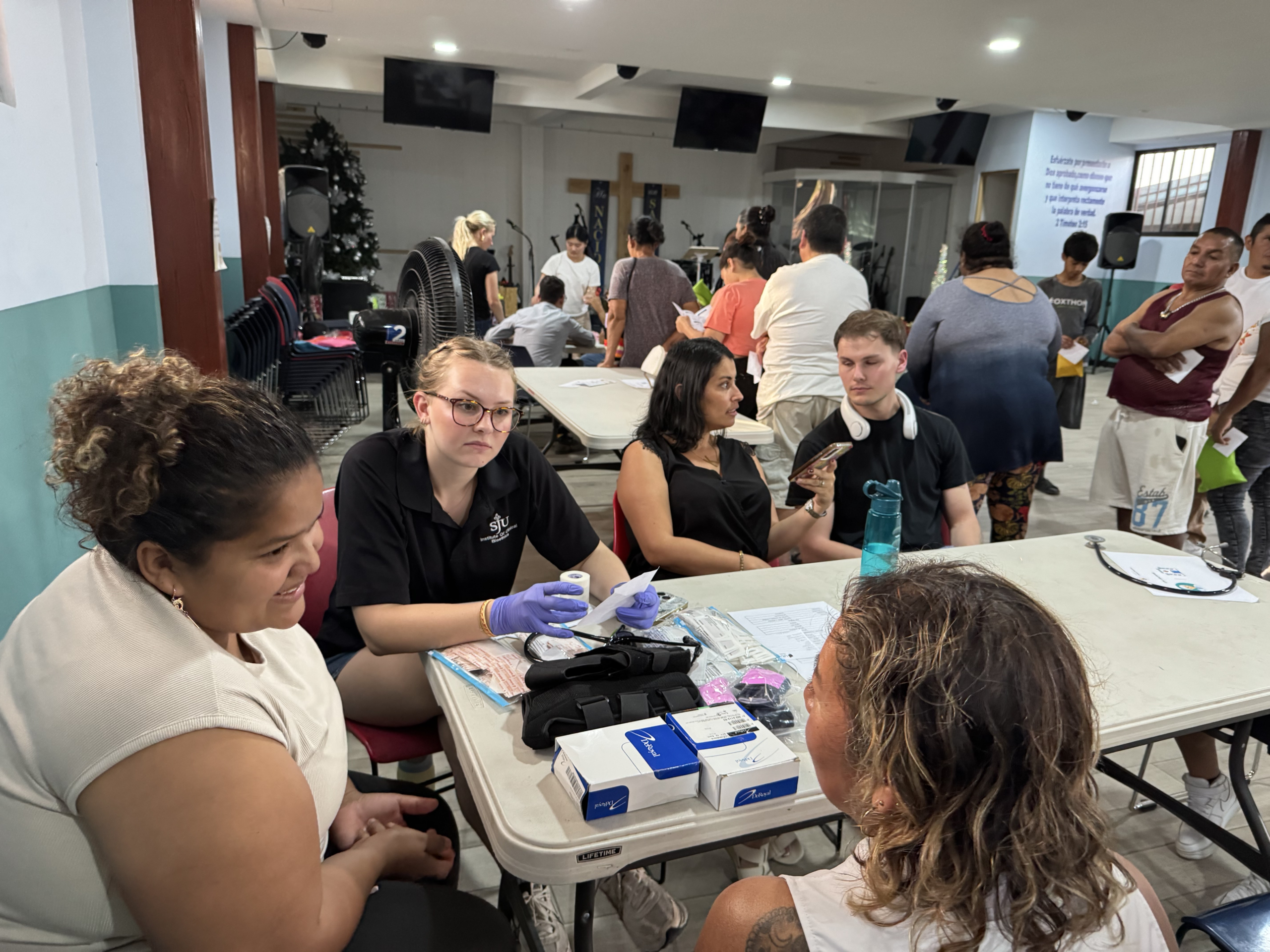
On our last night of reflection, Fr Clark asked our group what we could do to advocate for the people. And the room was silent. We weren’t nervous anymore, we were just stumped. Because what could we actually do? We saw things there that we’ll never forget. We had met the only physical therapist in the nursing home who provides services to 150 patients and never once sounded discouraged at the lack of assistance or the faulty equipment. We had met hospital/EBAIS (primary care) administrators who graciously gave us a tour of the hospital where we learned the EMTs must quickly grab the medications they anticipate needing as soon as they get the call, then they take off. We also met some of the wonderful Nicaraguan refugees living in El Carpio, next to the San Juan city’s trash dump. There was one EBAIS in the city, and many of the Nicaraguans were excluded from their care as they cannot afford to pay into the social security system. In an attempt to meet the needs of those without access to primary care, we set up a health promoter in the only affordable primary health care facility in the city of 40,000. With their help, we saw nearly 150 people in those 4 hours. I was examining their blood pressure, oxygenation, blood glucose and blood cholesterol level. Many of these people told me they were unable to go to a doctor in upwards of five years. Many of them had hypertension and many more had undiagnosed diabetes. I spent the past few years running the African Health promoter program with the rest of my team, but despite the language barrier and various other hiccups we experienced in Costa Rica, these people were among the most receptive and grateful I’ve met at a promoter. Everybody waited patiently in lines, everybody smiled, and everybody was willing to tell you whatever you asked them. We saw a man with a cataract that covered half his eye, a young boy whose genitals were bitten by a street dog and was now having pain along the stitches, and a woman wondering why she was having trouble getting pregnant. I’m sure they’ve forgotten my face but I definitely haven’t forgotten theirs. I’m still not really sure how I could make life better for those people. What it did make me remember was that even in Philadelphia, there are people without access to healthcare. There are people who are ignored and underserved. And even though I am still uncertain how to fix things in Costa Rica, I’m more dedicated than ever to be there for my neighbors who are in need.
Josh Frantz ’26:
This past semester, I enrolled in the course Just Health Care in Developing Nations, which explored both medical ethics and public health applied to developing nations. The course included a study tour to Costa Rica designed to demonstrate the realities of the health care system in a developing nation. A unique aspect of the trip was the opportunity to run a health promoter clinic in La Carpio, a Nicaraguan refugee camp. On the day of the clinic, my classmates and I traveled through La Carpio with locals to distribute flyers, giving us a firsthand look at living conditions that were far different from home. We saw an abundance of trash and sewage out in the open, spread by countless cats and dogs, and homes constructed from scrap metal found in the large community dump. Seeing these houses packed with children who should have been in school became a stark reminder of the challenges this community faces. The clinic itself was held in a local church with the help of Nurse Suzy, who has been serving the area for years. We saw nearly 150 patients, with a line stretching around the corner. As an EMT, I had the opportunity to take on the role of the resident, talking with patients about blood pressure, blood glucose, and cholesterol. It was heartbreaking to speak with so many people who knew they needed to improve their health but lacked the means to access basic care. Many of them had not seen a doctor in years or had never even had their blood pressure taken. I was grateful for the opportunity to listen to every patient and hear their stories. I like to think that I helped a few people, but for the most part, I believe they helped me and my classmates even more. They taught us what it really means to listen to somebody and have compassion even when there was nothing tangible to be done.
Isabella Jimenez ’27:
Over winter break, my classmates and I had the opportunity to take a trip to Costa Rica and perform a health promoter in La Carpio. La Carpio is a community in San José with a population made up of primarily Nicaraguan immigrants without legal status, restricting access to employment, limited education, and healthcare. The community is located next to a landfill where garbage is burnt at night, contributing to widespread respiratory issues amongst the population. Much of La Carpio’s infrastructure was built by the Nicaraguan’s, using tin and scrap metal collected from the landfill and carried on their backs to build homes for their families. Many of the Nicaraguan’s find work by boarding city buses, transporting them into the center city of San José and are dropped off at a park where they search for labor.
Prior to the health promoter, I walked around La Carpio with classmates and a local clinic nurse, Susie, to distribute flyers and encourage community members to attend. Susie was deeply embedded in the community, everyone knew her by name. She explained that she provides care to all individuals at her clinic, regardless of their ability to pay, highlighting the importance of accessible healthcare in a population where individuals have undiagnosed conditions. As we distributed flyers, community members were welcoming and willing to attend the health promoter, sharing the information with their families. After our outreach, we prepared to host the event. At the health promoter, we had numerous stations such as BMI, blood pressure and pulse oximetry, glucose and cholesterol, resident station, glasses, dental, and menstrual products. I was on the blood pressure and pulse oximetry station. As an EMT, I have experience with obtaining manual blood pressures and using pulse oximeters. Once the promoter began, community members entered the clinic and waited patiently as we guided them through each station. I was struck by how calm, respectful, and patient everyone was throughout the event. Despite seeing approximately 150 individuals, there was no rushing or complaining, everyone waited for their turn.
During the event, I personally obtained about 80 manual blood pressure readings. One blood pressure reading was particularly striking at 260/138 mmHg. The blood pressure was so elevated that I had to inflate the cuff 300 mmHg, as the pressure sounds were loud and unmistakable. My classmates at the glucose and cholesterol station later informed me this same patient had a cholesterol level of 541 mg/dL and significantly elevated glucose. When speaking to the patient, he explained he had recently arrived from Nicaragua and was unaware of his condition. I felt grateful he attended the health promoter this day, as his condition placed him at risk for a cardiac event. Susie intervened, providing insulin and blood pressure medication, and instructed the patient to visit her clinic the following day. This patient was one of the many cases of hypertension and hypercholesterolemia we saw during the health promoter. Unfortunately, these cases of hypertension and hypercholesterolemia stem from structural inequalities faced by the La Carpio community. Limited and unequal wages force many to rely on diets consisting almost exclusively of rice and beans, as fresh produce is comparatively expensive and inaccessible. It is frustrating to witness a community so kind, patient, and respectful being treated as expendable labor while being denied equitable access to wages, education, and healthcare.
It was difficult to accept how normalized this system appeared to be, with buses transporting workers in and out of La Carpio despite widespread awareness of the community’s living conditions. I am grateful for the opportunity to meet and serve the people of La Carpio, even if only for a few hours. Their resilience, strength, and gratitude, were unlike anything I have encountered at previous health promoters I have attended. La Carpio embodied a community, rooted in kindness, perseverance, and mutual support. I will never forget the compassion and respect with which I was treated.